Posts

The economics zeitgeist, 8 November 2009

Image
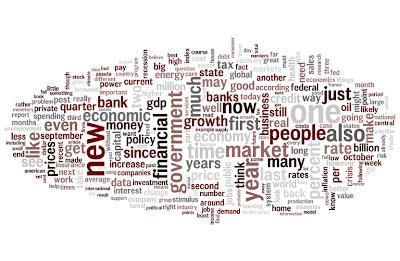
This week's word cloud from the economics blogs. I generate a new cloud every Sunday, so please subscribe using the RSS or email box on the right and you'll get a message every week with the new cloud. The words moving up and down the chart are listed here . I summarise around four hundred blogs through their RSS feeds. Thanks in particular to the Palgrave Econolog who have an excellent database of economics blogs; I have also added a number of blogs that are not on their list. Contact me if you'd like to make sure yours is included too. I use Wordle to generate the image, the ROME RSS reader to download the RSS feeds, and Java software from Inon to process the data. You can also see the Java version in the Wordle gallery . If anyone would like a copy of the underlying data used to generate these clouds, or if you would like to see a version with consistent colour and typeface to make week-to-week comparison easier, please get in touch.
An unanticipated surge of lending?

I've had this article in draft for about three weeks. Paul Krugman's latest item seemed an opportune moment to finish it. Intriguing article by Sheng and Pomerleano in the Economists' Forum about zero interest rate policy . I don't think I agree with what they are saying (insofar as I can even tell what they're saying) but it stimulates a few thoughts along Scott Sumnerish lines. One bit (from Kevin Warsh, quoted approvingly by the authors) jumped out at me: A complication is the large volume of banking system reserves created by the non-traditional policy responses. There is a risk, of much debated magnitude, that the unusually high level of reserves, along with substantial liquid assets of the banking system, could fuel an unanticipated, excessive surge in lending. Now surely a surge in lending is exactly what we want? Isn't all this monetary activism meant to increase the effective money supply (or counter a fall in velocity) therefore sustaining nominal GD...

How can rising productivity mean more staff?

This BBC article asserts that... Productivity, as measured by output per hour of work, rose at an annual rate of 9.5% between July and September. The data suggests that firms, which have cut jobs in the downturn, are now increasing their output, which may in turn lead to them needing more staff. This is truly a paradox. Greater productivity normally means firms need fewer staff - until, eventually, rising income increases aggregate demand, and then the laid-off people are employed in other sectors. The article seems to be another example of the equilibrium fallacy *, where a reversion to equilibrium is mistaken for a first-order effect. That is, firms cut staff because they had insufficient demand for their products - naturally, getting rid of the least productive staff. The remaining workers are more productive on average, and the reduction in output is less than the reduction in staff. This doesn't imply at all that either demand or output is increasing . If productivity had in...

No, really?

A good friend sent me a link to this unintentionally hilarious article about pricing on the iPhone App Store . I burst out laughing at the writer's tone of utter outrage . App developers are charging the price the market will bear, and it is lower than his moral intuition tells him it should be? The list of "complaints" in this article is hilarious: People used to sell apps for $50/year on Windows. When they moved to the iPhone, the optimal strategy was to sell it for $10/year. Therefore they sell it for $10/year. NO, REALLY? "Not all of the people investing time and money in their products are reaping the returns they expected." NO, REALLY? Someone had to price his app not on the basis of how much work he put in, but on the basis of what people would pay for it. NO, REALLY? The top ten apps list (which is based on the number of items sold, like every other top ten list in the world) is dominated by cheap applications and not by expensive ones. NO, REALLY? As t...

The economics zeitgeist, 1 November 2009

Image
This week's word cloud from the economics blogs. I generate a new cloud every Sunday, so please subscribe using the RSS or email box on the right and you'll get a message every week with the new cloud. The words moving up and down the chart are listed here . I summarise around four hundred blogs through their RSS feeds. Thanks in particular to the Palgrave Econolog who have an excellent database of economics blogs; I have also added a number of blogs that are not on their list. Contact me if you'd like to make sure yours is included too. I use Wordle to generate the image, the ROME RSS reader to download the RSS feeds, and Java software from Inon to process the data. You can also see the Java version in the Wordle gallery . If anyone would like a copy of the underlying data used to generate these clouds, or if you would like to see a version with consistent colour and typeface to make week-to-week comparison easier, please get in touch.

Lisbon treaty ratified

Vaclav Klaus has become the final European leader to sign the Lisbon treaty into law, enabling it to take effect across all 27 countries. This is good news from a purely practical point of view - it streamlines decision making and enables the EU to work more effectively with a growing number of member states. From a symbolic point of view things are more controversial. It is a declaration that the European institutions intend to move forward rather than fading into irrelevance, and there are a number of important symbols which will reinforce this in the public view. In ten years it is possible to foresee a European president coordinating and powerfully representing European interests in the world. Possibly even the beginning of a European economic or fiscal presence. And most importantly, a more powerful, legitimate and meaningful democratic process in Brussels and Strasbourg. Most people would regard most of these things - in isolation - as positive moves. But they will inevitably ta...

Superfreakonomics - wrong by a factor of nine

So tomorrow is the big day: the result of the Superfreakonomics counting contest ! My logarithmically scaled maximal-gap estimate , as you'll recall, was 88,782. This number was my carefully calibrated guess for the number of Google results shown for "Superfreakonomics". At first I was worried that my number might be too high . But in fact I was stunningly inaccurate in the other direction. The current figure, one day before the authors will calculate the final result, is 737,000 . It has been increasing at tens of thousands per day and will likely creep up a bit more before the search is carried out at 6am Eastern time tomorrow. Two scenarios are possible: Either, one of the other contestants has gamed the Google search in order to bring the results up to their guess - probably not worth it, as such skills are highly marketable in the search engine manipulation, I mean optimisation, industry. Then again, I've wasted a couple of hours writing about it by now so we can...