Posts

Showing posts with the label behavioural pricing

New research: *.99 no longer optimal for prices

The blog has been quiet for a while. I can now tell you the reason for this: I've been working on an intensive research project for the last couple of months. The Inon Pricing Research Centre has partnered with three retailers and two major consumer goods manufacturers to carry out the first detailed experimental tests of consumer responses to goods at different numeric price points. Everyone knows - or thinks they know - that prices such as £1.99, £5.99 or £9.99 are optimal price points for retail goods. Customers read the first digit first, and the last two are ignored - or at least, they have much less cognitive impact. In general, consumers were thought to put a subjective value estimate of about ten per cent less on an item priced at £3.99, than one at £4.00. However, despite a wide literature on behavioural economics and marketing, and a number of papers on pricing (for example this paper from Marco Bertini at London Business School ), this effect has not been properly te...

The price of Amazon Prime

An article in BusinessWeek about the success of Amazon Prime contains this interesting revelation: One challenge was selecting the annual fee for the service; there were no clear financial models because no one knew how many customers would join or how it would affect their purchasing habits. The team ultimately went with $79 mainly because it's a prime number. We see this problem a lot with our clients - new product or service launches are one of the main occasions when people hire us for pricing advice. But I have never yet seen anyone argue for a price level because of whether it factorises! Other interesting points: Amazon Prime in the UK costs £49 (not a prime number) and is one of the few items that is cheaper  in the UK than the US. It also provides next-working-day delivery in most cases, rather than the two-day US service. But then, the UK is a smaller place and perhaps delivery services are cheaper in general here. Finally, a funny quote from, of all people, a profe...

A story of perfect pricing

Thanks to Jonah Thomas , commenter on Marginal Revolution, for this beautiful story: I once talked to a Marine who had served in the Philippines. There was a guy who sold bananas right outside the base. He sold one bunch of bananas for ten cents, and he sold three bunches of bananas for 35 cents. The Marine tried to explain to the man that his pricing was wrong. "Look. I buy one bunch of bananas. Here's a dime. I buy a second bunch of bananas. here's another dime. I buy a third bunch. Three dimes. I came out ahead! I got 3 bunches of bananas for thirty cents! But you wanted to sell them for thirty five cents!" The man would stare blankly at him and never understood, no matter how hard he explained. Lots of Marines tried to explain it and the man never figured it out. Later my friend noticed that in town he could buy a bunch of bananas for 3 cents.

The FT's pricing department are cunning devils

Image
I finally got fed up of not being able to read FT articles after my debit card expired, so I went in to update the details. I'm not a huge fan of paying for content online - actually I'm not a huge fan of paying for anything, as both a Scot and an economist - and if I have to, I would prefer to pay per article. But the FT is both high quality, and its content is sufficiently important to this blog, that it's worth the subscription. My recollection of the price was around £6.99 a month [ I have now checked this - it was £6.25, dropping to £6.12 with the VAT cut last December ], so I was a little surprised to see this: They've upgraded me to a premium subscription by default, I thought - sneaky. I don't think I need a premium account - from memory it gives access to stock data or something else that I don't use. Easy, I thought - I'll go and change it back to a regular sub again. So click on 'Change or upgrade access level' and this is what you ...

Price trickery with T-shirts

Ed Kless at Verasage presents an interesting retail pricing scenario and asks for suggestions . Best to read his post and look at the pictures before continuing, otherwise the following will not quite make sense. If you're reading offline, here is his summary of three racks in a clothes shop: The first offered two tee-shirts for $30 or $19.50 each. The second, right next to it offered two tee-shirts for $30, but no mention of individual price and the third rack had individual tee-shirts for $15 each. My thoughts: I've noticed recently that a few places which charge "$N for two" will happily sell you a single one for $N/2. If there's no price for the single item then I imagine this would be the default policy. I'd suggest that the existence of these two apparently redundant offers is metered price discrimination - capturing people with a higher willingness-to-pay by selling them an extra product rather than charging a higher unit price. The $30 vs $...

More on Amazon pricing

Image
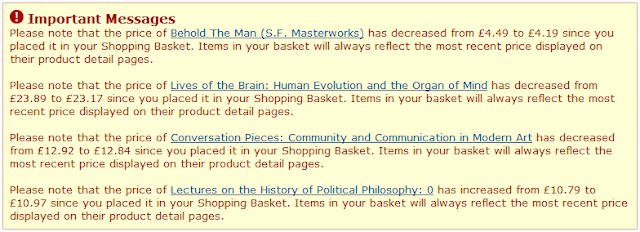
You might remember a previous discussion of Amazon's pricing policy. I came across a further thread about it on... Amazon's own website ! I hope that guy with the last comment is doing it for research purposes and not because he thinks it will save money. Some theories from that discussion: currency fluctuation (which is plausible); stock position of different suppliers (not so much); testing of the demand curve via small price adjustments (quite an interesting hypothesis and certainly possible); and adjustments to changing demand (if true, would reveal a surprisingly detailed understanding of demand for individual books - but you never know). Another possibility: it could be driven by competition - but as the market leader, it's less likely that Amazon adjusts its price to competitors than vice versa. Maybe then they deliberately make frequent pricing changes to stop competitors from finely undercutting them. Anyone know whether competitors can use Amazon's API to...