Posts

Saving: vice or virtue

From Mario Rizzo's comment on Coordination Problem (an Austrian blog): Keynes...does turn certain virtues (like saving) into vices -- from an economic or consequentialist perspective. What is particularly disturbing is that from a long-run perspective surely saving is a "virtue." But surely it's not. Investment  is a virtue; and saving, usually, is what enables investment. Saving in itself is a neutral act, because one person's savings are another person's debt. In the Keynesian model, attempts to increase saving while investment is falling simply lead to a spiral of shrinking income. It's investment that creates future wealth. According to the savings identity , total savings does equal investment, but that statement is misleading for two reasons: one, because this definition of investment includes inventory (which may be built up involuntarily, and is not especially "virtuous"); and two, because it hides the effects of savings in one peri...

Where did Ireland's money go?

Whenever I see some huge figure for an institution's "losses" I am suspicious. Ireland has now supposedly spent about 55% of its GDP , or €100 billion, to bail out its banks and buy toxic property assets from them. But they haven't created  anything with this money - it hasn't been spent on goods or services. In fact, it's just a transfer. So where is the money now, and has anything of economic value actually been lost? Partly the story is similar to that in the UK - lots of people who had a property and sold it in 2007 have made a ton of money. Many of the people who bought the properties have now handed the properties - and the debt - over to the government. But at average Irish house prices, that €100 billion is about 500,000 houses - and surely that number of people did not exit the housing market (in a population of 4.4 million). Even if they had, the government has certainly not foreclosed on (or acquired) 100% of the relevant mortgages. Beneficiar...

A story of perfect pricing

Thanks to Jonah Thomas , commenter on Marginal Revolution, for this beautiful story: I once talked to a Marine who had served in the Philippines. There was a guy who sold bananas right outside the base. He sold one bunch of bananas for ten cents, and he sold three bunches of bananas for 35 cents. The Marine tried to explain to the man that his pricing was wrong. "Look. I buy one bunch of bananas. Here's a dime. I buy a second bunch of bananas. here's another dime. I buy a third bunch. Three dimes. I came out ahead! I got 3 bunches of bananas for thirty cents! But you wanted to sell them for thirty five cents!" The man would stare blankly at him and never understood, no matter how hard he explained. Lots of Marines tried to explain it and the man never figured it out. Later my friend noticed that in town he could buy a bunch of bananas for 3 cents.

Fellatio targeting

The French MEP and ex-justice minister Rachida Dati has entertained legions of Youtube viewers  with a slip of the tongue - intending to state that "inflation" was close to zero, but instead claiming "fellatio" was close to zero. Fortunately, we hear, the European Central Bank is responding in a timely manner to this problem, with a "moral easing" or ME policy. In contrast to its attitude to inflation, the ECB board - especially its French and Dutch members - are quite concerned about a shortage of fellatio in the economy. They are willing to print as many euros as it takes - and distribute them wherever necessary - to return fellatio to its trend rate. As precedent they have cited Oval Office policy during the Clinton administration. Some economists have claimed that fellatio targeting is not the appropriate measure, and instead the overall level of orgasms in the economy (also known as NGDP, or Number of Groans Derived from Poking) should be the con...

The shrinking names of economists

Image
Paul Krugman bemoans an externality imposed on him by Narayana Kocherlakota (or his ancestors): the need to fit more letters into a short column, the more he is discussed. While this problem has been solved over at WCI (see what I did there?) by compressing him to NK, this is a risky policy due to the frequent mentions of New Keynesian models alongside his name. Paul suggests that all economists should have short names like Ip and Ng. If this a problem now, surely it was a bigger problem in the days of mechanical movable type. With modern typesetting software and the greater readership of electronic media, long names are now more affordable to the reader. We can test this hypothesis statistically. Let's start with the founders of economics in the 18th century: Hume, Smith and Mill. So far, so good. Indeed, the first entry in my Routledge " Fifty Major Economists " is the tiny-surnamed Thomas Mun. In the 19th century the theory was developed further by Ricardo,...

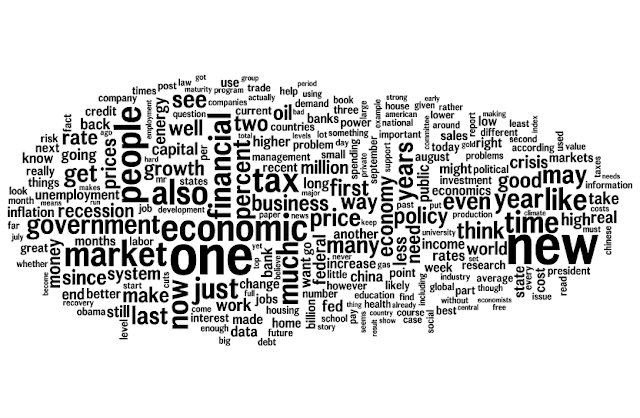
The economics zeitgeist, 26 September 2010

Image
This week's word cloud from the economics blogs. I generate a new one every Sunday, so please subscribe using RSS or the email box on the right and you'll get a message every week with the new cloud. The words moving up and down the chart are listed here . I summarise around four hundred blogs through their RSS feeds. Thanks in particular to the Palgrave Econolog who have an excellent database of economics blogs; I have also added a number of blogs that are not on their list. Contact me if you'd like to make sure yours is included too. I use Wordle to generate the image, the ROME RSS reader to download the RSS feeds, and Java software from Inon to process the data. You can also see the Java version in the Wordle gallery . If anyone would like a copy of the underlying data used to generate these clouds, or if you would like to see a version with consistent colour and typeface to make week-to-week comparison easier, please get in touch.

Noun, noun, noun, noun, noun, noun, noun, verb

News headlines naturally need to be compact and punchy, and they have a certain distinct grammar which is recognisable at a glance. Often a noun is used as an adjective, or a verb elided, as in "Labour leader vote close". But the headline I saw on the BBC website today takes this principle just about to its outer limit. Six nouns are converted into adjectives one after the other, each one raising the stakes of an extraordinary portmanteau noun phrase: MS charity respite home closure protest vote fails The story is here , if you can figure out quite what it means.