Posts

"Ant mega-colony takes over world"

Best article title I've seen since Super Cally Go Ballistic, Celtic are Atrocious and Diana fund pays out to Gypsies and Asylum Seekers in the Express .

Bad mathematics and dodgy economics

Robert Peston today attempts to demonstrate that bank executives have ripped off bank shareholders over the last twenty years or so since deregulation of the City. However he does so with some classic statistical tricks. See which ones you can spot in the article if you wish, before I carry on... (note that these tricks are actually courtesy of Andrew Haldane, a director of the Bank of England - Robert just communicates them to us) from 1900 to 1985, the financial sector produced an average annual return of around 2% a year, relative to other stocks and shares...But in the subsequent 20 years, from 1986 to 2006, returns went through the roof: the average annual return soared to more than 16% OK so far (though that "relative to other stocks and shares" is a bit tricky, because it's aready quite a meaningful excess return - banks haven't always been as safe as Robert and Andrew suggest). But now what's happened? The collapse of banks' share prices in the past t...

Links and (not-so) brief comments on Krugman, behaviour and long-termism

Image
Any of these links could have made a blog posting of its own, but instead why not help yourself to a high-density nutritious snack selection of random commentary? During the first lecture of Paul Krugman's London visit last month he commented that the economy might be "stabilising". The stockmarket leapt a hundred points (giving rise to much hilarity on the second and third evenings). This perceptive writer points out a similar occasion in 1929 when someone "of no great note" called Roger Babson made a comment that the market was due to crash. At which point it duly crashed - for the next twenty-five years. Now a little later in the Robbins lectures Paul Krugman reviewed a history of not the 1929 but the 1873 depression - and how the economy recovered from that, in the absence of the modern era's gifts of Keynesian stimulus and World War II. Nothing to do with the earlier comments...except for one little thing... An interesting behavioural marketing tactic ...

Paul Krugman versus the stimulus

Image
Many of you will have noticed Paul Krugman's continuing demands for a bigger fiscal stimulus - he thinks it should be around double the size proposed by the administration. If nothing else, we have to give him credit for being consistent, right? Well...maybe not. You see, I came across an old article where he was, as usual, insisting that the stimulus should be doubled...but only to $600 billion! A double-take. Could it ever be true that the administration was proposing only a $300 billion stimulus? Yes it could - in fact in the early days of the election campaign Obama's proposal was for a stimulus of $60 billion . No wonder Paul originally supported Hillary. I thought it would be interesting to run a comparison of Paul Krugman's desired stimulus versus the stimulus proposed (and eventually passed) by the Obama administration. Here it is (click on the graph for a larger version). The red line is the administration's efforts and the blue is what Paul wants: The red lin...

Should governments manage their finances like households?

Generally it's a fallacy to suggest that governments should act like ordinary people in managing their debts. Governments have a responsibility to consider the effects on the rest of the economy - whether in economic stimulus, or the effect on long-term interest rates of an increased debt burden, or the fact that they create a destination for excess desired savings. So does this apply to the financing of aircraft carriers which Robert Peston reports today? As Peston says, the government appears to be acting like a cash-constrained household - deferring payments now and accepting that they'll have to pay more in the future. This may be perfectly logical for households - if they need to buy a car that they can't afford, the value to them of having access to the car may exceed the extra payments, especially if it helps people get to work and earn more money. But for governments there are different ways of borrowing money. The way Peston presents this it looks like vendor fina...

Should contracts be allowed to overrun their budget?

I was curious to notice that the UK's aircraft carrier contracts have been allowed to overrun their budget by around 25% . This seems to be a common phenomenon in public sector contracts - but should it be? Why aren't the contracts signed at a fixed cost with the private sector allowed to take the risk? This is a common question in my own field of software development. There are traditionally two ways you can approach a contract - with a third variation now emerging which might solve some of the traditional conflicts between client and supplier. The old-fashioned approach - which I believe is still used in many military contracts - is that the supplier bills on a time and materials basis. This reduces the risk for the supplier and places it all on the client. This may well be appropriate if the client is responsible for specification and design - if that is the case, the supplier might not be able to estimate the timescale accurately enough, and many overruns are caused either ...

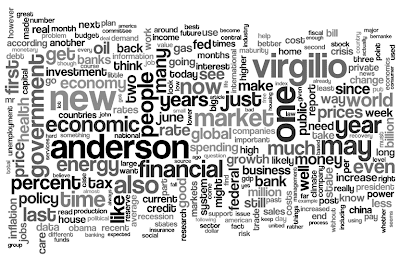
The economics zeitgeist, 28 June 2009

Image
This is a word cloud from all economics blog postings in the last week. I generate this every Sunday so please subscribe using the links on the right if you'd like to be notified each time it is published. It has been constructed from a list of economics RSS feeds from the Palgrave Econolog and other sources, and uses Wordle to generate the image, the ROME RSS reader to download the RSS feeds, and Java software from Inon to process the data. You can also see the Java version in the Wordle gallery . The millionth Wordle is coming up in about a week, so look out for that. If anyone would like a copy of the underlying data used to generate these clouds, or if you would like to see a version with consistent colour and typeface to make week-to-week comparison easier, please get in touch. Special this week : Guest appearance from Virgilio Anderson .